

Dipteryx alata
| Dipteryx alata | ||||||||||||||||
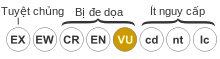
| Tình trạng bảo tồn | ||||||||||||||||
|---|---|---|---|---|---|---|---|---|---|---|---|---|---|---|---|---|
| Phân loại khoa học | ||||||||||||||||
|
||||||||||||||||
| Danh pháp hai phần | ||||||||||||||||
| Dipteryx alata Vogel |
||||||||||||||||
| Danh pháp đồng nghĩa | ||||||||||||||||
|
Coumarouna alata (Vogel) Taub. |
Dipteryx alata (Baru) là một loài rau đậu thuộc họ Fabaceae. It là một large tree usually referred to as "Baruzeiro" (Baru tree) in Portuguese and its fruits or almond-like beans are known as Baru. Other names besides Baru are Cumaru and Cumbaru.
Nó chỉ được tìm thấy ở the Cerrado region of Brazil and is threatened by habitat loss. Historically it has been used as lumber, for charcoal production and for shadow in pastures. The fruits are used as bovine feed or as nourishment and are also an important food source for native animals species as small mammals, rodents, birds, bats, etc.
The tree can measure up to 25 m in height, 0.7 m in diameter and have a useful lifespan of 60 years. A tree will produce about 150 kg of fruit per harvest.
Its fruits, which are brown in color, are either collected off the floor or picked from the tree when they are almost ripe. A fruit usually weighs 25g of which 30% is pulp, 65% is ligneous endocarp and 5% is seed (bean/almond).
Out of the fruit, the pulp is sweet and can be consumed but is also used to manufacture jams and liquors; the beans (Baru almonds) are rich in flavor and are typically served after being roasted and salted or as a part of any number of dishes as bread, cakes, Pesto sauce and ice cream; additionally the oil extracted from the almonds may be used as a culinary ingredient or in many other varied forms. Baru is known to be rich in proteins, fibers, magnesium, potassium and iron and to have a high energetic content.
The uses for the Baru fruit can be summarized as [cần dẫn nguồn]:
| Part of the Fruit | Product/Sub-Product | Uses |
|---|---|---|
| Pulp | Pulp in natura | Human food |
| Animal food | ||
| Medicinal/Pharmaceutical | ||
| Dehydrated Pulp | Human food | |
| Animal food | ||
| Medicinal/Pharmaceutical | ||
| Flour | Human food | |
| Alcohol/Liqueur | Human consumption | |
| Medicinal/Pharmaceutical | ||
| Cosmetics | ||
| Industrial | ||
| Residues | Farming (organic fertilizer) | |
| Almond | Raw almond | Human food |
| Animal food | ||
| Medicinal/Pharmaceutical | ||
| Agricultural (seeding) | ||
| Roasted Almond | Human Food | |
| Flour | Human Food | |
| Milk | Human Food | |
| Oil | Human food | |
| Medicinal/Pharmaceutical | ||
| Cosmetics | ||
| Industrial | ||
| Cake | Human food | |
| Medicinal/Pharmaceutical | ||
| Cosmetics | ||
| Industrial | ||
| Paste/Butter | Human food | |
| Ligneous endocarp | Charcoal | Fuel |
| Pyroligneous acid and tar | Industrial | |
| Ligneous Endocarp | Artisanry |
Additionally [cần dẫn nguồn]:
| Per 100 g | |
|---|---|
| Protein | 23.9 g |
| Total fat | 38.2 g |
| Saturated fat | 7.18 g |
| Unsaturated fat | 31.02 g |
| Total fiber | 13.4 g |
| Carbohydrates | 15.8 g |
| Calcium | 140 mg |
| Potassium | 827 mg |
| Phosphor | 358 mg |
| Magnesium | 178 mg |
| Copper | 1.45 mg |
| Iron | 4.24 mg |
| Manganese | 4.9 mg |
| Zinc | 4.1 mg |
| Calories | 502 |
| Wikimedia Commons có thêm hình ảnh và tài liệu về: Dipteryx alata |
Nguồn [sửa]
- World Conservation Monitoring Centre 1998. Dipteryx alata. 2006 IUCN Red List of Threatened Species.blavla Truy cập ngày 10 tháng 7 2007.
Xem thêm [sửa]
Portuguese Wikipedia article on Baru